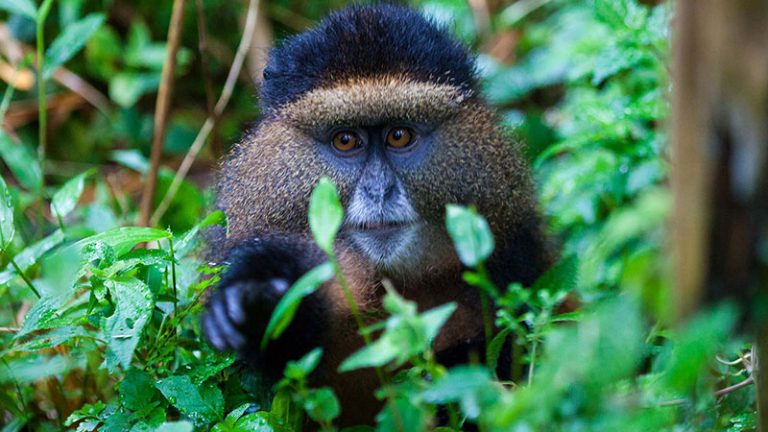
The Golden Monkey (Cercopithecus kandti) is a rare, beautiful, and endangered primate. They are a subspecies of the Blue Monkey and are known for their striking appearance and playful behavior. They are a key species for conservation and tourism in Rwanda.
1. Where They Are Found in Rwanda
In Rwanda, Golden Monkeys are found in one specific and critically important location:
- Volcanoes National Park (Parc National des Volcans): This world-famous park in northwestern Rwanda is part of the larger Virunga Massif, which Rwanda shares with Uganda and the Democratic Republic of Congo. The park is home to the country’s population of Mountain Gorillas and is the primary habitat for the Golden Monkey. Within the park, the monkeys live in the dense bamboo forests on the slopes of the volcanoes. The troops (groups) that are habituated for tourism are typically found in the sectors bordering Mount Sabyinyo and Mount Karisimbi.
Seeing them requires obtaining a Golden Monkey Tracking Permit from the Rwanda Development Board (RDB), similar to the gorilla trekking permits but generally less expensive.
2. What They Eat (Diet)
Golden Monkeys are primarily herbivores (plant-eaters), but their diet is varied and adapts to seasonal availability. Their diet consists mainly of:
- Bamboo: This is a staple food. They eat young bamboo shoots, leaves, and the soft inner pith. Several troops in Volcanoes National Park have a diet overwhelmingly dominated by bamboo.
- Fruits: They enjoy a variety of fruits when in season.
- Leaves and Foliage: They consume leaves from various other plants and trees in the forest.
- Flowers and Insects: For protein, they will supplement their diet with insects, larvae, and flowers.
- Bark and Fungi: Occasionally, they will also eat tree bark and fungi.
Their strong jaws and teeth are adapted for chewing tough bamboo.
3. How They Survive (Survival Strategies)
Golden Monkeys have developed several key strategies to thrive in their challenging mountain habitat:
A. Social Structure:
- Troop Life: They live in large, cohesive troops ranging from 30 to over 80 individuals. This safety-in-numbers approach is their primary defense against predators.
- Strength in Numbers: A large troop has many eyes and ears to spot danger. They are very vocal and will sound alarm calls if a threat is detected.
- Complex Social Bonds: They spend a great deal of time grooming each other, which strengthens social bonds, maintains hygiene, and reduces conflict within the troop.
B. Adaptations to Habitat:
- Agile Climbers: They are incredibly agile, spending most of their time in the trees. Their long tails help with balance as they leap through the dense bamboo forest canopy.
- Camouflage: While their bright fur seems conspicuous to us, in the dappled light of the bamboo forest, their golden-orange backs and bluish-grey limbs can provide surprisingly good camouflage.
- Dietary Flexibility: Their ability to eat a wide range of plants, especially the abundant but tough bamboo, allows them to survive in a habitat with limited fruit resources compared to lower-altitude rainforests.
C. Daily Activity Patterns:
- Diurnal: They are active during the day, foraging for food in the morning and late afternoon.
- Midday Rest: They often rest and socialize during the heat of the midday, which helps conserve energy.
D. Reproduction:
- They do not have a strict breeding season, which allows for births throughout the year and a steady population growth.
- Females care for their infants for an extended period, teaching them what to eat and how to navigate the forest, ensuring the next generation’s survival.
Threats and Conservation in Rwanda
Despite their successful adaptations, Golden Monkeys are endangered. The main threats they face are:
- Habitat Loss: The primary threat. The land around Volcanoes National Park is densely populated, leading to pressure for agriculture and resources. Habitat fragmentation isolates troops.
- Poaching: While less common today, they were historically caught in snares set for other animals and were sometimes hunted for their beautiful fur.
- Climate Change: Changes in temperature and rainfall patterns can affect the growth of the bamboo and other plants they depend on.
Conservation Efforts in Rwanda are robust and have been highly successful:
- Protected Area: Volcanoes National Park is a strictly protected area, patrolled by rangers to prevent poaching and illegal activities.
- Tourism Revenue: The Golden Monkey tracking permits generate significant revenue. This money funds park management, anti-poaching patrols, and community development projects, giving local people a direct incentive to protect the monkeys and their forest.
- Community Engagement: A percentage of the tourism revenue is shared with communities living around the park, funding schools, health clinics, and clean water projects. This reduces their dependence on the forest’s resources.
In summary, the Golden Monkey is a remarkable primate that survives through its strong social bonds, dietary flexibility, and agility. In Rwanda, they are a conservation success story, found exclusively in the bamboo forests of Volcanoes National Park, where carefully managed tourism plays a vital role in ensuring their long-term survival.